
In the wake of recent major revelations of organized financial crime in the Nordics, most businesses have heightened their defenses. However, the reality is that the most dangerous type of fraud rarely storms through open doors. It slips in unnoticed, disguised as "well-behaved" companies that look completely green and innocent on paper.
Traditional credit bureaus often only scratch the surface, looking at historical data, static ratings, and isolated financial figures. But modern fraud operates in networks and leaves digital footprints across multiple data sources. To catch these patterns in time, you need to look at the entire puzzle. That is exactly what Risika’s Fraud Module is built to do.
Fraud Indicators: Signals, Not Final Verdicts
When we work with fraud detection at Risika, we operate by one vital principle: a single irregularity does not make a business criminal. There can be completely legitimate, operational reasons why a company triggers one of our indicators. Our module does not pass a final judgment on your customers, it functions as an intelligent smoke alarm prompting you to take a closer look.
Here are some of the key factors the system monitors:
Geographical Distance (Distance to CEO): Our data shows that 3 out of 4 directors in the Nordics live within 10 km of their company. If a director suddenly resides 300 km away or in another country, it could indicate a front person, but it could also simply be a remote tech company.
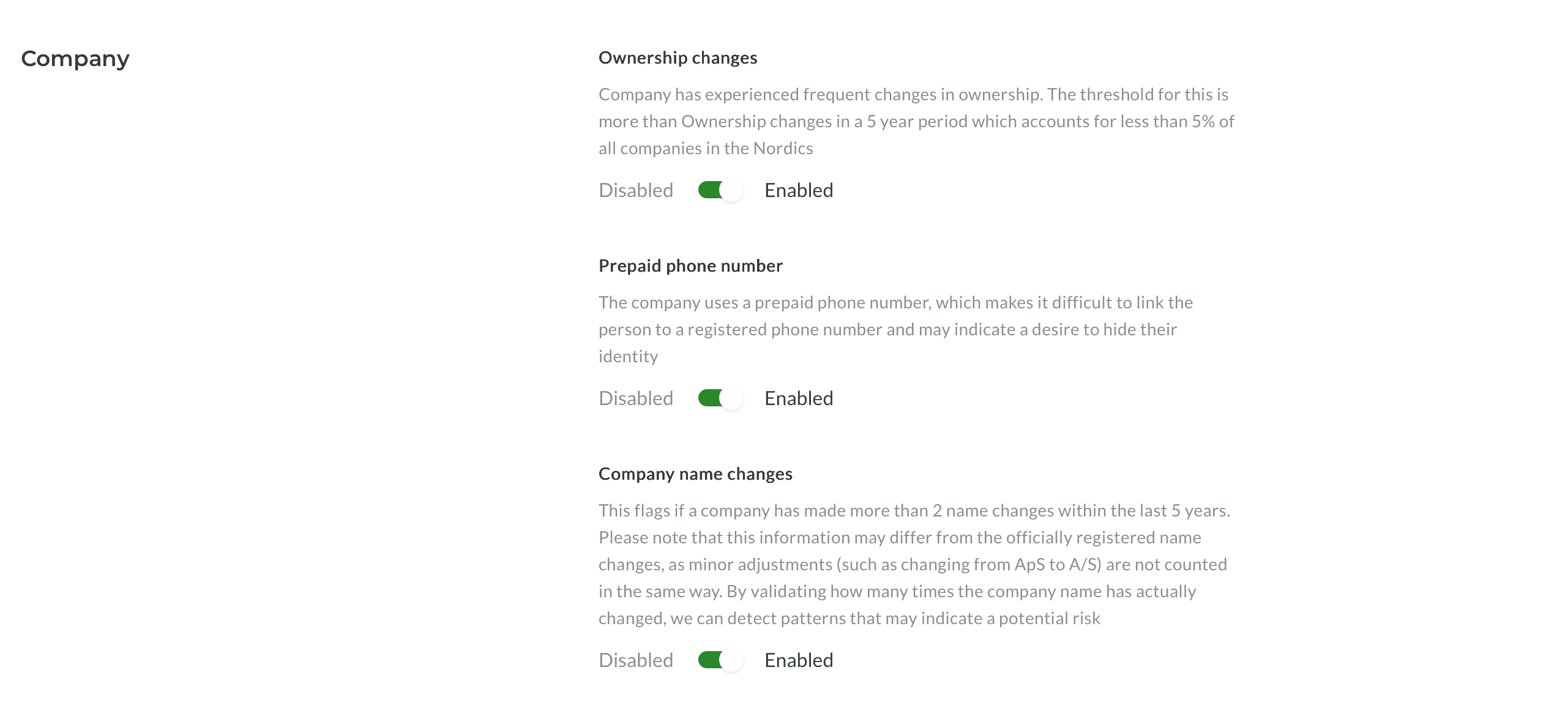
Prepaid Phones: The use of prepaid mobile numbers has exploded by 234% since 2016. While historically viewed as suspicious, our data shows that it is now completely standard behavior for many small, healthy firms.
Duplicated Financial Statements: This occurs when key financial figures and balance sheets are copied 1:1 across different entities. It could be a sloppy clerical error by an auditor, but statistically, it is one of the heaviest indicators that someone is trying to inflate their creditworthiness artificially.
The Puzzle: When Indicators Become a Pattern
Why is the big picture so crucial? Because the truth only reveals itself when you combine the data.
If a new customer applies for a large credit line and the system shows they use a prepaid phone, you will likely approve the order without a second thought. It’s standard behavior.
However, if that same customer has simultaneously changed their address three times in the past year, appointed a director living 400 km away, and presents a financial statement that is a mirror image of a recently bankrupt company—you no longer just have a prepaid phone. You have a pattern.
This is where Risika’s Fraud Module brings transparency: we gather these scattered data points from across the Nordic business registries and present them as a single, unified risk profile.
From Gut Feeling to Nuanced Dialogue
The purpose of this approach is not to force you to say no to every potential customer. The purpose is to provide your finance team with an objective foundation for a nuanced conversation. When the system flags a pattern, you can meet the customer with transparency: "We would love to do business with you, but we see some irregularities in the data. Therefore, we will start with upfront payment for the first three orders."
Conclusion: Protect Your Bottom Line with the Big Picture
Modern risk management isn’t about being paralyzed by paranoia; it’s about having the right tools to look behind the facade. When you understand that fraud indicators are signals meant to be read in context, you can protect your business from catastrophic million-euro losses, without standing in the way of your sales department's growth.